
JOINT PAIN
Does Cold Weather Affect Arthritis?
Knees, joint pain and what may help when the season turns.

The first cool mornings of fall have a way of announcing themselves in the knees. You stand up from the couch and the joint takes a second to agree with you.
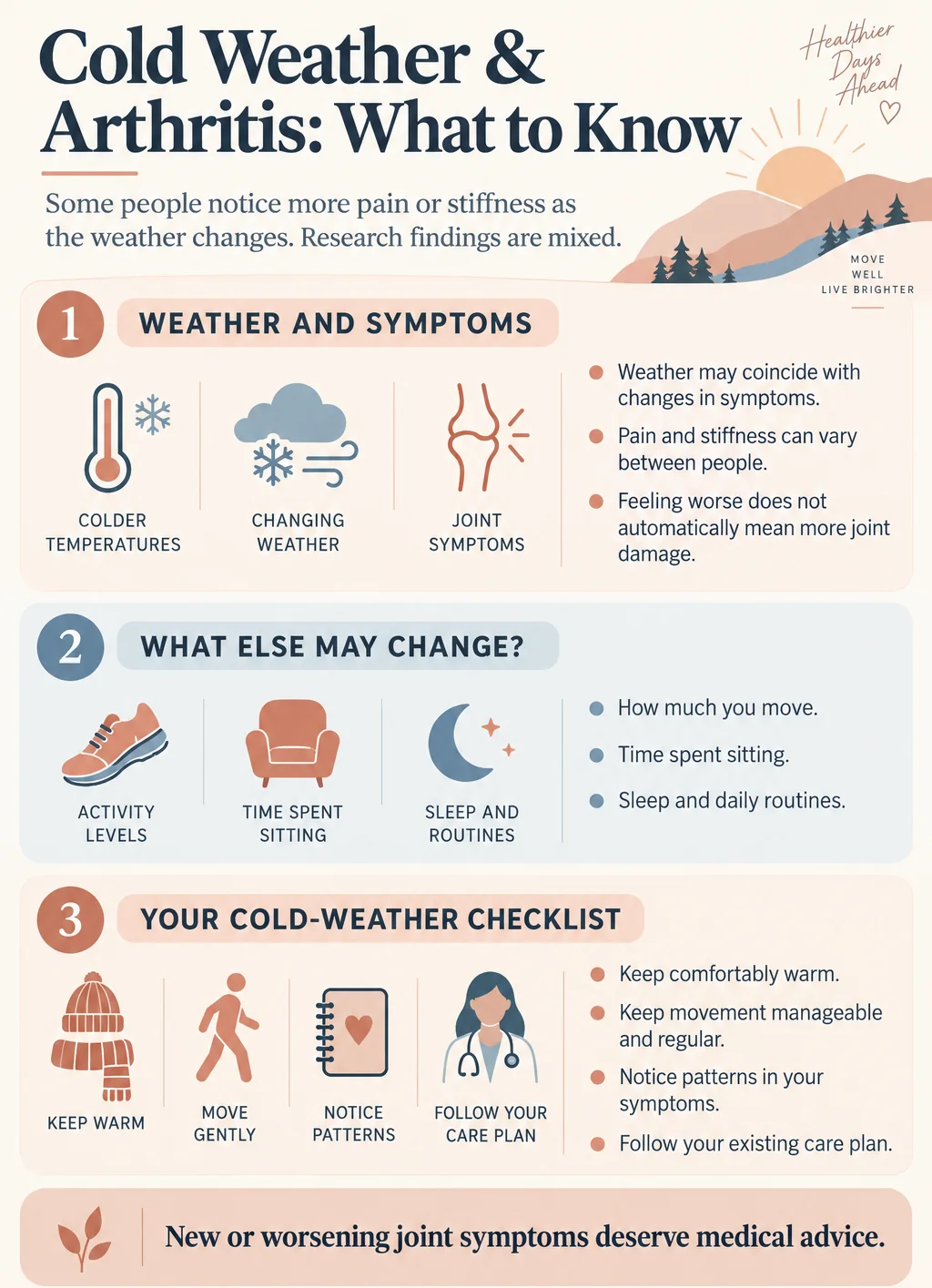
So, does cold weather affect arthritis? The honest answer is that for some people the symptoms do feel worse, and the research is still arguing about why. One large study found a small link between pain and damp, windy, low-pressure days. A more recent pooled review found no link at all. Cold on its own comes out weaker than most people expect.
One thing is clearer. A joint that hurts more in November is not necessarily a joint that has gotten worse. Symptoms and damage are different things.
Below: what the studies found, why knees complain first, how the two main types of arthritis differ in the cold, what tends to help, and where red light therapy fits.
Does cold weather cause arthritis, or affect existing symptoms?
Cold weather does not cause arthritis. No major arthritis organization lists climate as a cause, and there is no evidence that living somewhere cold gives you osteoarthritis or sets off rheumatoid arthritis.
What cold can do is change how a joint you already have feels. Three situations get mixed up:
- Developing arthritis. A diagnosis, made by a clinician from your history, an examination and often imaging or blood tests. Weather is not part of it.
- Existing arthritis feeling worse. Pain, stiffness and swelling rise and fall for many reasons, and weather may be one of them for some people.
- Joint pain with no diagnosis. Cold, achy knees in your fifties might be early osteoarthritis, an old injury, a muscle problem, or nothing that needs a name yet.
"Arthritis from cold" is a phrase people search for, not a condition a doctor writes down. A bad week in a cold snap does not mean the cartilage changed that week.
Why might arthritis feel worse in cold weather?
What studies say about weather and joint pain
The two biggest recent studies point in different directions, which is the honest state of the science.
The first is a UK smartphone study nicknamed Cloudy with a Chance of Pain, published in npj Digital Medicine in 2019. It followed 2,658 people with long-term pain, most with arthritis, for over a year against local weather data. On damp, windy, low-pressure days the chance of a worse-pain day was about 20 percent higher than average. Humidity had the strongest link. Temperature on its own had no significant link at all.
The second is a 2024 systematic review in Seminars in Arthritis and Rheumatism that pooled 11 studies, 15,000 people and 28,000 episodes of new or worsening pain. Combined, temperature, humidity, air pressure and rain were not associated with the risk of knee, hip or low back pain, or rheumatoid arthritis flares. The one exception was gout, where hot, dry weather roughly doubled the risk of a flare.
These studies used different populations, methods and measures of pain, which may help explain their different findings. Together, they leave uncertainty about how weather affects individual symptoms. Neither establishes that cold weather damages joints.
Possible explanations for increased discomfort
Nobody has proved a mechanism, and the season changes more than the thermometer. The proposed explanations are:
- Barometric pressure. When pressure falls ahead of bad weather, tissue around a joint may expand slightly and press on nerves that are already sensitive. Plausible, hard to measure, and the effect in the smartphone study was small.
- Cold and stiffness. Cold may thicken the fluid inside a joint and tighten the muscles around it. If so, that is a stiffness effect, not damage, and it eases as you warm up.
- Muscle tension. Bracing against the cold, hunching your shoulders, walking carefully on wet ground. Tense muscles pull on sore joints.
- Less movement. Shorter days and wet pavements mean fewer walks, and a joint that moves less stiffens more.
- Worse sleep. Dry heated air, earlier dark, more time indoors. Poor sleep lowers pain tolerance the next day. Our guide to getting quality sleep at night is a good place to start.
- Longer sitting. Evenings on the couch under a blanket are lovely for everything except knees.
- Mood. The smartphone study found the weather link held even after accounting for mood, but low mood still makes pain harder to carry.
Not everyone gets the same pattern. Some people are worse in humid summers. Some feel nothing. The tracking section below is how you look for yours.
Does cold weather affect arthritis in the knees?
Knees are usually the first joint people mention. They carry your body weight, they have a large joint space that can swell, and osteoarthritis picks them more often than almost any other joint. The moments people describe:
- Getting out of bed, or standing after sitting. The joint has been still and the muscles around it have cooled. The first few steps are the worst, then it loosens. In osteoarthritis that stiffness typically passes within 30 minutes.
- Walking outside. Cold air on thinly covered knees, plus a careful, shortened stride on wet leaves or ice, which makes hips and knees work harder.
- Stairs. Going down loads the kneecap more than going up. A stiff, cool joint does not like it.
Knee pain in cold weather is not automatically arthritis. An old meniscus injury, tendon irritation and simple deconditioning all flare in the same weather. If your knee is new to hurting, get it looked at rather than assume. The practical help below applies either way.
Does cold weather affect osteoarthritis and rheumatoid arthritis differently?
Osteoarthritis and cold weather
Osteoarthritis is the wear type. The National Institute of Arthritis and Musculoskeletal and Skin Diseases defines it as a degenerative joint disease in which the tissues in the joint break down over time. People with it often report more stiffness in cold, damp weather. The 2019 smartphone study, mostly this group, found a small association. The 2024 review found no added risk of a knee or hip pain episode.
Rheumatoid arthritis and cold sensitivity
Rheumatoid arthritis is an autoimmune disease in which the immune system attacks the joint lining. NIAMS lists stress, environmental factors and too much activity as flare triggers. Cold hands are common in RA, but cold sensitivity is not the same as a flare, which is the disease becoming more active. The 2024 review found no link between weather and flare risk, so a flare on a cold day is still a flare, and your rheumatology team wants to hear about it.
| Question | Osteoarthritis | Rheumatoid arthritis |
|---|---|---|
| What kind of condition is it? | Wear and breakdown of joint tissue over time. Usually one or a few joints, often knees, hips and hands. Morning stiffness under 30 minutes. | An autoimmune disease. The immune system attacks the joint lining, usually on both sides of the body. Morning stiffness over 30 minutes, often with fatigue. |
| What is known about weather sensitivity? | Many report more stiffness in cold, damp weather. A 2019 study found a small link with humidity and pressure. A 2024 review found no added risk of a pain episode. | Cold hands and stiffness are common. The 2024 review found no link between weather and flare risk. Flares are driven by the disease, not the forecast. |
| What should you pay attention to? | Morning stiffness that starts lasting longer than 30 minutes, swelling that stays, or a joint you are avoiding using. | Hot, swollen joints, morning stiffness past an hour, fatigue or low fever. Those are flare signs and belong in a call to your rheumatology team. |
What may help with arthritis symptoms in cold weather?
None of this replaces the plan you already have with your doctor. It sits beside it.
Keep joints comfortably warm
- Layer over the joints that complain. Knee sleeves, fingerless gloves indoors, a thermal layer under trousers. Warmth eases stiffness, and a light compression sleeve gives some people a sense of support.
- Warm the joint before you use it. A warm shower in the morning, or a heat pad on the knees for 15 to 20 minutes before a walk.
- Warm, not hot. Warm to the touch is enough. If you have diabetes, poor circulation or reduced feeling in your feet, check with your doctor before using heat pads at all.
Keep moving with manageable activity
Movement is the one thing every arthritis guideline agrees on. The CDC says physical activity can help people with arthritis reduce joint pain and improve function and mood, and suggests working toward 150 minutes a week of moderate activity plus two days of strength work, choosing activities that cause little or no pain. In cold months that might look like:
- A ten-minute walk after lunch, when the day is warmest.
- A stationary bike indoors, if cold pavements are the problem.
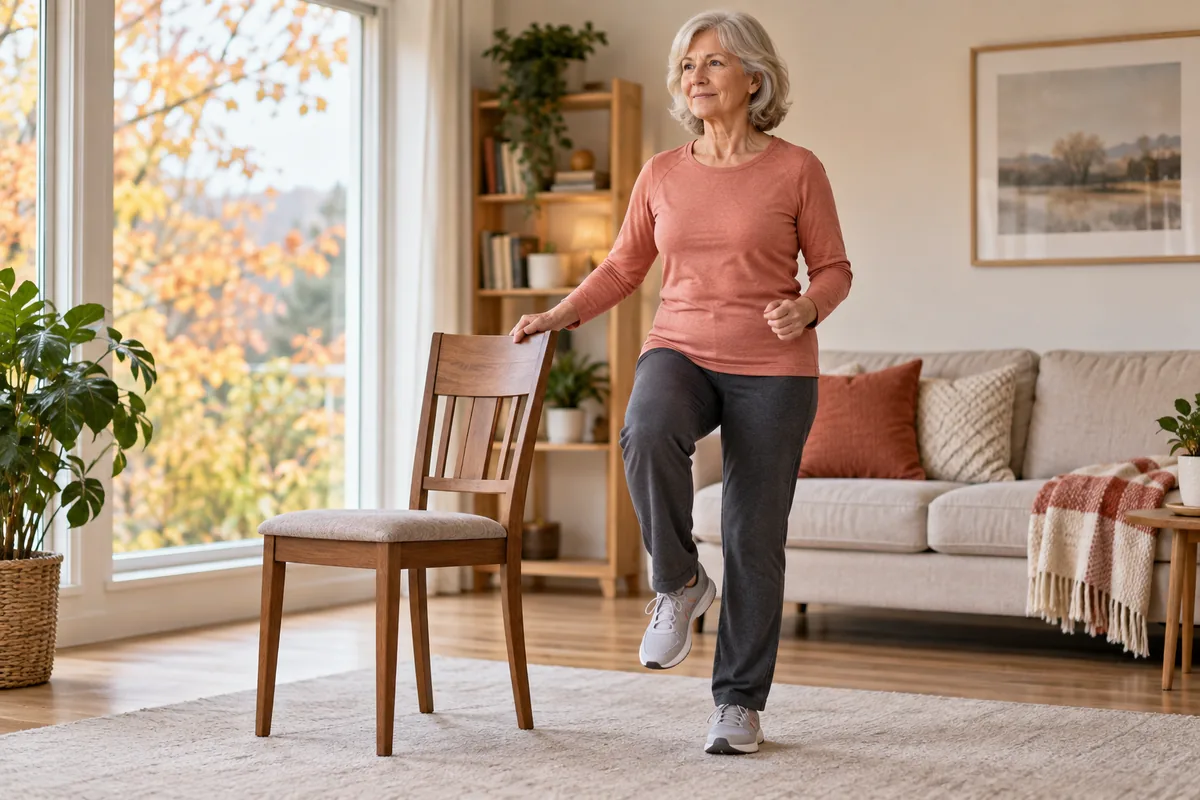
- Chair-based mobility: ankle circles, knee extensions, opening and closing your hands while the kettle boils.
- Water exercise at a heated pool, which many people with knee arthritis find is the easiest place to move.
Start below what you think you can do and build. Soreness that settles by the next day is normal. If pain is worse for more than a day or two, ease back and adjust. For severe or persistent symptoms, contact your doctor, which is what the CDC guidance advises too.
Break up long periods of sitting
Stiffness builds in stillness. The gap between sitting down at 7pm and standing at 10pm is where a lot of cold-weather knee pain is made. The easiest rule: stand up every time an episode or an ad break ends. Walk to the kitchen, do ten slow sit-to-stands from the chair, come back. Thirty seconds every half hour costs nothing.
Follow your existing treatment plan
If you take medication for arthritis, keep taking it as prescribed. A bad month is not a reason to double a dose or to stop because it "isn't working." NIAMS names suddenly stopping medication as a trigger for RA flares.
If the plan is not holding through winter, that is a normal conversation to have with your doctor or rheumatologist. People adjust with the seasons all the time.
Track patterns that matter to you
Once a day, note: pain out of 10, how long you were stiff in the morning, how much you moved, how you slept, and what the weather did. A notes app or a paper diary is fine. After six weeks you may notice a pattern: whether your knees really do seem worse on damp days, or whether the harder days follow the ones you skipped walking.
A diary cannot separate the weather from everything else going on, but it gives you and your clinician something concrete. "It is worse in cold weather" is a feeling. "Pain averaged 6 on the 12 days it rained and 3 on the rest" is something to work with.
Can red light therapy help arthritis pain?
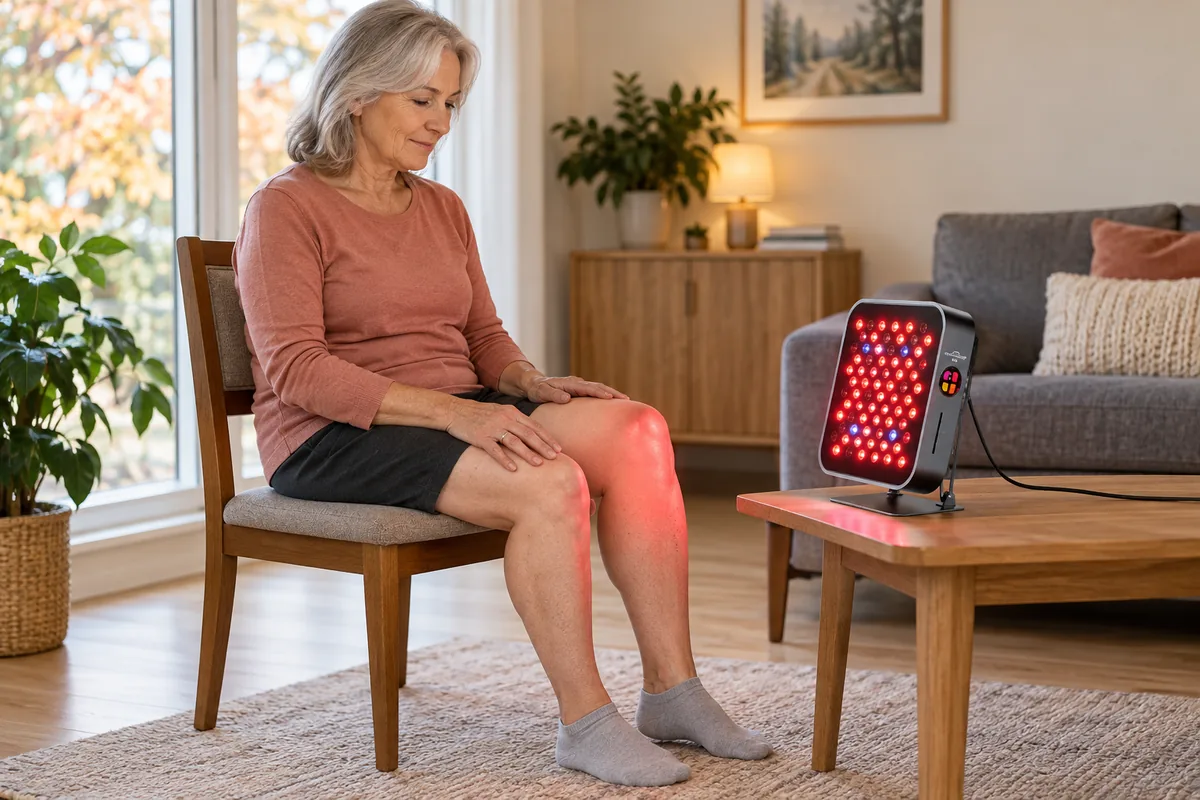
Red light therapy, also called photobiomodulation, shines red and near-infrared light, roughly 630 to 900 nanometers, onto the skin without much heat. In clinics it is usually delivered by a low-level laser. At home it is usually an LED panel. Same wavelengths, different devices, and most of the research used lasers. The idea is that cells absorb the light and respond with a small lift in energy production and blood flow. For arthritis, the research is more encouraging than most home-gadget claims and less settled than the marketing suggests.
- Knee osteoarthritis. A 2019 systematic review in BMJ Open pooled 22 placebo-controlled trials with 1,063 people. Low-level laser therapy reduced pain and disability compared with sham treatment, but only within specific dose and wavelength ranges. Outside them the benefit was absent.
- Rheumatoid arthritis. A 2005 Cochrane review of six small trials found laser therapy reduced pain by about 1 point on a 10-point scale and cut morning stiffness by roughly 28 minutes over up to four weeks. The effect did not last at three months, most trials treated the hands, and the review is now 20 years old.
The catch for home use: those trials used clinic lasers with a measured dose on a measured spot. A home LED panel is a different device, and its output, distance and session length decide whether it gets anywhere near a studied dose. So a home panel is a possible support alongside movement, warmth and your existing care, never a substitute for any of them.
For the wider picture, our overview of red light therapy benefits covers skin, sleep and recovery uses, and the red light device reviews explain what to look for on a spec sheet.
If you have rheumatoid or psoriatic arthritis and take immunosuppressants or biologics, or you take any medication that makes your skin light-sensitive, talk to your rheumatologist before starting any light therapy.
When should you seek medical advice about joint pain?
Most cold-weather joint pain is a nuisance, not an emergency. Some of it is not.
Get urgent help the same day if a joint:
- Becomes suddenly and severely painful, usually just one joint.
- Is hot, red or swollen, especially with fever, chills or feeling generally unwell.
- Cannot bear weight or be moved.
The NHS lists these as the signs of septic arthritis, an infection inside the joint that needs treatment straight away.
Book a routine appointment if:
- A joint has hurt for more than a few weeks and is not settling.
- Morning stiffness is getting longer, especially past an hour.
- Swelling keeps coming back, or joints on both sides of the body are involved.
- Pain is stopping you sleeping or doing ordinary things.
- You have never had a diagnosis and the pain is new.
The weather is a convenient explanation, and sometimes a wrong one. New or fast-changing symptoms deserve a look whatever the forecast says.
This article is for general information and is not medical advice. Arthritis is a medical condition, and what helps one person may not suit another. Talk to your doctor, rheumatologist or pharmacist before changing how you manage it, especially if you are pregnant or breastfeeding, have diabetes or poor circulation, or take regular medication.
Frequently asked questions
- Is damp weather worse for arthritis than dry cold?
- Some research links higher humidity and lower air pressure with worse pain, while other studies find no clear association. There is no reliable rule that damp weather is worse for everyone. Tracking symptoms alongside activity and sleep may help you notice your own patterns.
- Can changes in barometric pressure affect joint pain?
- Possibly, and only a little. Falling pressure was linked with slightly higher odds of a bad pain day in the 2019 smartphone study, perhaps because lower outside pressure lets tissue around a sensitive joint expand. It has not been proven, and a 2024 pooled review found no link.
- Is heat or cold better for arthritis symptoms?
- Heat for stiffness, cold for a hot, swollen joint. Warmth loosens muscles and eases the morning stiffness of osteoarthritis. Cold numbs pain and reduces swelling during a flare. Either for about 20 minutes, with a cloth between the pack and your skin, and warm rather than hot.
- Does more pain in winter mean my arthritis is getting worse?
- Not by itself. Pain and joint damage move on different clocks. A stiff, achy winter usually reflects cold, less movement and worse sleep, not faster wear. What needs checking is a change that persists: longer morning stiffness, swelling that stays, or a joint you can no longer use normally.
- Can people without arthritis have joint pain in cold weather?
- Yes. Old injuries, tendon problems, tight muscles and simply moving less all ache more in cold weather without any arthritis. If the pain is new, keeps returning, or comes with swelling, it is worth a diagnosis rather than a guess.
Where to go from here
Back to that first cold morning. The knee that took a second to agree with you is probably the same knee it was in August: cooler, stiffer and moving less, and all three of those you can do something about. If red light therapy interests you as a support, start with the red light therapy benefits overview.