
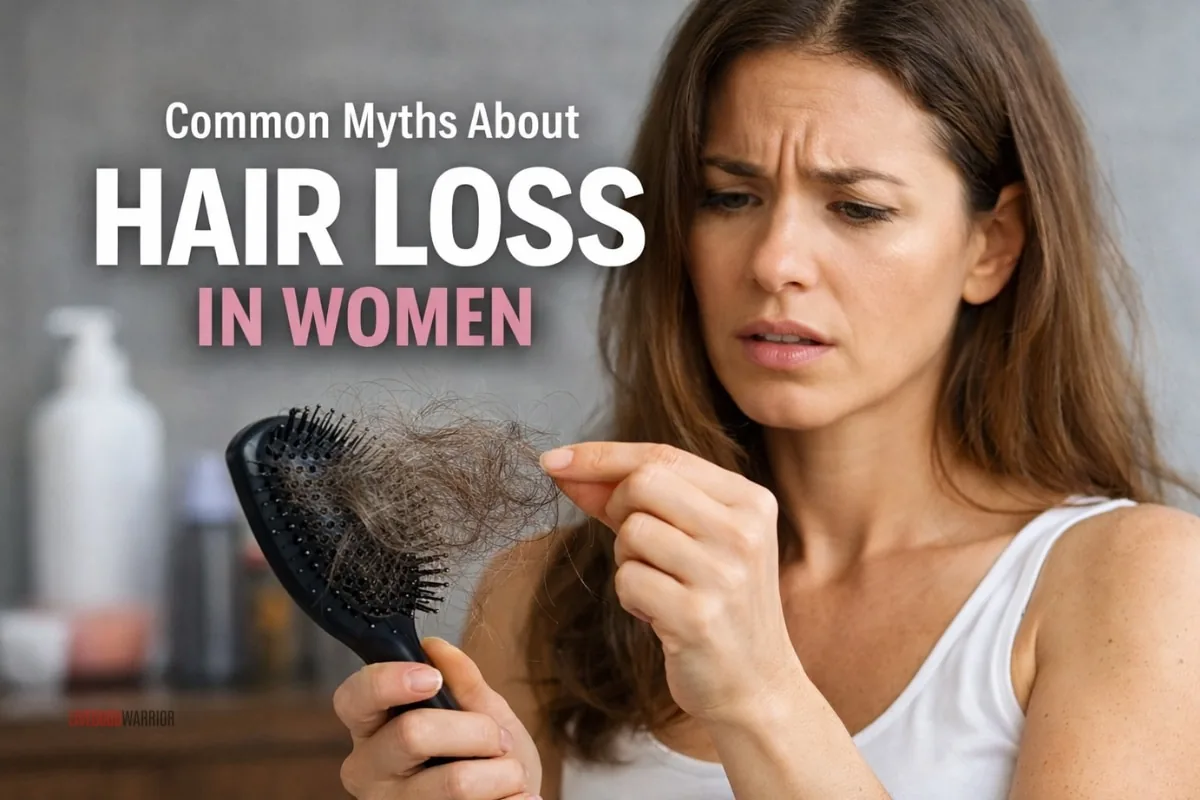
Hair loss in women happens more often than people think.
Sometimes it comes from medical conditions. Sometimes from hormones. Sometimes, from everyday habits, we barely notice.
But there is another problem too.
There are many myths about hair loss in women floating around. Things people repeat as if they are facts. Advice from friends. Old beliefs. Internet rumours.
And when you start losing hair, those myths can make everything feel worse.
So let’s slow down for a moment.
And look at some of the most common myths about hair loss in women.
Myth #1 – Hair Loss Is Only A Problem For Men
This one sits at the top of the list for a reason. It’s probably the most common belief among the many myths about hair loss in women.
When most people think about hair loss, they picture a man with a receding hairline or a bald spot on the crown of his head. That pattern is very visible, so it gets talked about more.
But hair loss is not just a man’s issue.
Women experience it too. Much more often than people realise.
The difference is that it usually looks different in women.
Men often lose hair in clear patterns:
- a receding hairline
- bald spots on the crown
- eventually larger areas of baldness
Women usually notice something more subtle.
Instead of a bald patch, the hair tends to thin across the scalp. The ponytail feels smaller. The part in the hair gradually widens. The scalp may start peeking through where it never did before.
These are the kinds of experiences that often get buried under the many myths about hair loss in women, making it harder to recognise what is really happening.
And sometimes it starts with small things that are easy to dismiss.
At least, that’s how it began for me.
First, it was the brush.
Suddenly, it seemed full of hair every time I used it.
Then, after washing my hair, I started noticing strands everywhere.
On my hands.
On the shower wall.
Slowly sliding toward the drain.
You try to tell yourself it’s normal. That everyone sheds hair.
But then you look at your braids.
Mine used to be thick. Heavy.
Now they’re starting to look more like a proverbial rattail.
And that’s when it really hits you.
But you’re not.
Many women first notice things like:
- more hair in the shower drain
- more strands on the pillow
- a brush filling up faster than it used to
- the part in their hair looking wider in photos
This type of thinning is often called female pattern hair loss. And it is surprisingly common.
By midlife, many women will notice some degree of hair thinning. It doesn’t always lead to baldness, but it can still feel upsetting when it happens.
So the idea that hair loss only affects men is simply not true.
Women experience hair loss, too.
It just tends to show up in quieter ways.
Myth #2 – Hair Thinning Only Happens When You Get Older
A lot of people believe this one.
They assume hair loss only happens later in life. Something you deal with in your fifties or sixties. Not when you’re young.
But that’s another one of the many myths about hair loss in women.
Hair thinning can start much earlier.
For some women, it begins in their twenties.
For others, it can even show up during the teenage years.
In my case, it started with my first pregnancy.
At first, I thought it was just one of those temporary things. Hormones do strange things during pregnancy and after birth. But the changes in my hair were one of the first times I really started paying attention to what was happening.
Pregnancy and the months after birth are common times for women to notice shedding. Hormone levels shift quickly, and the hair growth cycle reacts to that change. Many women experience postpartum hair shedding, which can be noticeable but is usually temporary.
Hormones are not the only reason hair thinning can begin earlier in life.
Other factors can also play a role:
- Genetics – if hair thinning runs in the family
- Hormonal changes such as puberty, pregnancy, birth control, or thyroid issues
- Stress on the body, including illness or major life stress
- Rapid weight loss or restrictive dieting
- Nutrient deficiencies, especially iron or vitamin D
Sometimes the hair doesn’t fall out in dramatic clumps.
Instead, it happens quietly.
The ponytail feels thinner.
The part slowly widens.
More hair ends up in the brush than before.
And because it happens gradually, many women don’t notice it right away.
So while age can influence hair thinning, it is not the only reason it happens.
Hair loss can begin at many different stages of life.
Sometimes much earlier than people expect.
Myth #3 – Wearing Hats Too Often Can Cause Hair Loss
This is one of those ideas that has been repeated for years.
Some people believe that wearing hats too often causes hair loss. The reasoning usually goes something like this: your scalp needs to “breathe,” and if you cover it with a hat, the hair follicles don't get enough oxygen.
But that is not how hair works.
This belief is simply another one of the many myths about hair loss in women.
Hair follicles do not get oxygen from the air. They receive oxygen and nutrients through the bloodstream via microcirculation. So wearing a hat does not suffocate your hair or stop it from growing.
In other words, simply wearing a hat will not cause hair loss.
In fact, hats can sometimes be helpful.
They can:
- Protect the scalp from strong sun exposure
- Shield hair from UV damage
- Give a bit of confidence on days when thinning hair feels more noticeable
For many women dealing with hair thinning, a hat can simply make the day easier.
That said, there are a couple of small things to keep in mind.
A hat could contribute to problems only if it creates constant pulling or irritation.
For example:
- Hats that are very tight can put pressure on the hairline
- Repeated pulling on the same area can lead to traction alopecia over time
- Hats that are dirty or rarely washed can irritate the scalp
But those situations are about tension or hygiene, not about the hat itself.
A normal, comfortable hat that fits well won't make your hair fall out.
So if you like wearing hats, there is no reason to stop.
Your hair follicles will still get the oxygen they need, whether your head is covered or not.
Myth #4 – Cutting Your Hair Makes It Grow Faster

This is one of those tips that almost everyone has heard at some point.
Someone says:
“Just trim your hair regularly. It will grow faster.”
It sounds logical. But it isn’t quite true.
And it’s another example of the many myths about hair loss in women that keep circulating.
Hair does not grow from the ends.
It grows from the hair follicles in the scalp.
So when you cut the ends of your hair, you are not affecting the part that controls growth. The follicle under the skin determines how fast hair grows.
Hair growth follows a natural cycle that includes:
- a growth phase (anagen)
- a resting phase (telogen)
- a shedding phase
This cycle happens inside the follicle. Cutting the ends of your hair does not change that process.
That said, trims still have their place.
Regular trims can help with the appearance and condition of the hair. When the ends become dry or damaged, they start to split. Those split ends can travel farther up the hair shaft, making the hair look thinner and frizzy.
A small trim can help by:
- removing split ends
- preventing further breakage
- making the hair look thicker and healthier
So, trimming your hair can improve how it looks, but it does not make it grow faster.
Hair growth is controlled by the follicle in the scalp, not by the scissors at the ends.
Myth #5 – You Inherit Hair Loss From Your Mother
This is another belief that gets repeated a lot.
People often say that if your mother has thinning hair, you will probably lose your hair too. And if she has thick hair, you are safe.
But that is an oversimplification.
And it’s one more example of the common myths about hair loss in women.
Hair loss related to genetics does not come only from your mother. The genes involved can come from either side of the family.
That means hair loss patterns may be influenced by:
- your mother’s side of the family
- your father’s side of the family
- a combination of both
Sometimes a woman notices thinning hair even though her mother never had that issue. When she looks further into the family history, she may discover that an aunt, grandmother, or even relatives on her father’s side experienced similar hair thinning.
Genetics can be complicated like that.
It also does not guarantee that you will lose your hair just because someone in the family did. Family history can increase the likelihood, but it does not make the outcome certain.
In some cases, genetic hair thinning may:
- appear later in life
- develop very slowly
- skip one or more generations
This type of thinning is often called female pattern hair loss. It usually appears as a gradual thinning across the top of the scalp rather than a receding hairline.
So while genetics can play a role, the idea that hair loss comes only from your mother is simply not accurate.
Myth #6 – Washing Your Hair Every Day Makes It Fall Out More
This is another one of those beliefs that causes unnecessary worry.
Many people think that if they wash their hair every day, they will lose more of it. When they see strands in the shower or in the drain, it feels like the washing itself must be causing the hair to fall out.
But that’s not how it works.
This is one of the common myths about hair loss in women.
Hair naturally sheds as part of its normal growth cycle. Most people lose about 50 to 100 hairs a day. These hairs have already reached the end of their growth phase and are ready to fall out.
When you wash your hair, those loose strands simply get released all at once. That is why it may look like washing is causing the loss, even though the shedding would have happened anyway.
So washing your hair daily does not cause hair loss.
What matters more is how you treat your hair and scalp during washing.
Some things can irritate the scalp or weaken the hair shaft over time, such as:
- shampoos with very harsh ingredients
- excessive scrubbing or rough handling
- using very hot water
- heavy buildup from styling products
If the scalp becomes irritated or inflamed, it can affect the overall health of the hair.
Keeping the scalp clean is generally a good thing. Washing removes excess oil, sweat, and product buildup that can accumulate on the scalp.
A gentle routine usually works best:
- use a mild shampoo
- Massage the scalp gently rather than scrubbing
- rinse thoroughly
- avoid overly hot water
In the end, how often you wash your hair is mostly a matter of personal preference and hair type.
The important thing to remember is that washing your hair does not cause it to fall out, even though it may look that way when you see strands in the shower.
Myth #7 – Brushing Your Hair When It Is Wet Causes More Hair Fall

Many people have heard this warning.
“Never brush your hair when it’s wet. It will make your hair fall out.”
It’s one of the common myths about hair loss in women, but the truth is a little more nuanced.
Brushing wet hair does not cause hair to fall out from the follicle. The hair you see in your brush has usually already reached the natural shedding stage of the hair cycle.
In other words, those hairs were going to fall out anyway.
But there is a small detail worth understanding.
Hair is more fragile when it is wet.
When hair absorbs water, the strands stretch slightly. That makes them softer and easier to break if they are pulled or brushed roughly. What often happens during wet brushing is breakage, not true hair loss from the root.
So the issue is not shedding.
It is how gently the hair is handled.
A few simple habits can help reduce breakage:
- use a wide-tooth comb instead of a stiff brush
- start detangling from the ends and slowly work upward
- avoid pulling or forcing knots apart
- gently pat hair dry with a towel instead of rubbing it
If you are careful, brushing or combing wet hair is generally fine.
The strands you see in your brush are often part of the normal daily shedding cycle, not something caused by brushing itself.
So while wet hair should be handled gently, the idea that brushing it automatically causes hair loss is simply another misunderstanding.
Myth #8 – All Hair Loss Is Permanent
When hair starts falling out, it’s easy to assume the worst.
Many women quietly worry that once hair is gone, it is gone forever.
But that is not always true.
This belief is another persistent myth about hair loss in women.
The reality is that many types of hair loss are temporary. Once the underlying cause improves, the hair can often begin growing again.
Hair grows in cycles. Sometimes something disrupts that cycle and pushes more hairs than usual into the resting and shedding phase. When that happens, shedding can increase for a while.
But once the body returns to balance, the follicles can start producing new hair again.
Some common situations where hair loss may be temporary include:
- post-pregnancy shedding (postpartum hair loss)
- stress-related shedding, sometimes called telogen effluvium
- rapid weight loss or restrictive dieting
- illness, surgery, or high fever
- certain medications
- temporary nutrient deficiencies
For example, many women notice significant shedding a few months after giving birth. This happens because hormone levels change quickly after pregnancy. As those hormone levels stabilise again, the hair cycle often returns to normal and new hair begins to grow.
Recovery does not happen overnight.
Hair grows slowly, usually about one centimetre per month, so it can take several months before the hair starts looking fuller again.
And in some cases, hair may not return exactly to the thickness it once had. But many women do see noticeable improvement once the underlying trigger is addressed.
Of course, not all hair loss is temporary. Some types, such as genetic hair thinning, can be more long-term.
But the important thing to remember is this:
Hair loss does not automatically mean permanent loss.
In many cases, the follicles are still there. They just need the right conditions to begin growing again.
Myth #9 – Hair Care Products Can Fix Hair Loss
When hair starts thinning, the first instinct is often to look for a product that promises to fix it.
A special shampoo.
A miracle serum.
A bottle that claims to “regrow hair in weeks.”
The shelves are full of them.
And that is why this belief is one of the most persistent myths about hair loss in women.
Most over-the-counter hair care products cannot actually treat the underlying cause of hair loss. Shampoos, conditioners, and styling products mainly work on the hair shaft, the part of the hair you can see.
But hair growth happens deeper in the skin, inside the hair follicle.
If hair thinning is caused by internal factors, such as hormones, genetics, illness, or nutrient deficiencies, a shampoo alone cannot solve the problem.
That does not mean all hair products are useless. Some can help improve the appearance and condition of the hair by:
- reducing breakage
- improving scalp cleanliness
- making hair look fuller or healthier
But they do not usually change how the follicle functions.
There are a few medical treatments that doctors sometimes recommend for certain types of hair loss, but those are very different from cosmetic hair products sold as quick fixes.
It is also worth paying attention to what you put on your scalp.
Some hair products contain ingredients that may irritate the scalp or cause buildup for some people. A sensitive or inflamed scalp is not ideal for healthy hair growth.
When choosing hair products, it can be helpful to avoid formulas that contain large amounts of potentially irritating ingredients, such as:
- phthalates
- parabens
- 1,4-dioxane (sometimes listed as dioxane contaminants)
- strong artificial fragrances
Keeping the scalp clean and using gentler products can support overall hair health.
But the key point is this:
Hair care products alone rarely fix hair loss.
When hair thinning appears, the real cause is often inside the body rather than in the shampoo bottle. Understanding that difference is an important step toward finding solutions that actually help.
Understanding the Truth Behind Myths About Hair Loss in Women

As you can see, there are quite a few myths about hair loss in women floating around. Many of them have been repeated for years, so it’s easy to mistake them for facts.
But hair thinning is rarely caused by something simple like wearing a hat or brushing your hair the wrong way.
In reality, hair health is connected to many things happening inside the body. Hormones, stress, genetics, and overall nutrition can all play a role.
Sometimes the body is simply missing important nutrients.
Two nutrients that often come up when doctors evaluate hair thinning are:
- iron
- vitamin D
Low levels of these nutrients have been associated with hair shedding and thinning in some women. When the body is lacking key building blocks, hair is often one of the first things to show it.
Supporting the body with proper nutrition can make a difference over time. That may include improving diet, checking nutrient levels, or using a quality multivitamin for women with iron or a Vitamin D supplement when appropriate.
Hair thinning can feel frustrating and personal. But understanding the real causes helps remove some of the fear created by outdated advice and common myths about hair loss.
0 Comments